
I have been marking privately the recent 150th anniversaries of events leading up to the U.S. Civil War (e.g., 06 November 2010 was the 150th anniversary of the election of Abraham Lincoln as President of the United States and 20 December 2010 was the 150th anniversary of the secession of South Carolina). I have been thinking for some time of starting a project of tracking my various ancestors through the years of the Civil War. I thought a good way to start was to introduce my various ancestors using the 1860 United States Federal Census. Any notes added in "[]" are mine and not in the actual census records. In the census listing I have made bold the names of my ancestors.
Schoen
Jacob and Margarethe (Jost) Schön lived in the small town of Kübelberg in the Rhineland-Palatinate in Southwestern Germany. They had 2 daughters and 4 sons. All four of their sons immigrated to the United States. Peter, Nicholas, and Joseph Schoen all settled in New York City. Their second son, Johannes, followed many of their relatives and neighbors from the Kohlbach valley and settled in Washington County, Ohio. I'll have more to say about the New York Schoen's later in the project but I haven't yet been able to find them in the 1860 census.
Johannes and Margaretha (Bender) Schoen immigrated with their two living sons, Frederick (age 7) and Karl (age 7 months) in July 1856. Originally, the lived in the "immigrant quarter" on South Hart Street in Marietta, Ohio, which is where we find them in 1860. Listed on Page No. 78 of the "Free Inhabitants of the 2nd Ward Marietta City in the County of Washington State of Ohio enumerated by me, on the 13th day of June 1860. L. L. Laflin, Ass't. Marshal. Post Office Marietta."
Dwelling No. 554, Family No. 554:
John Shane, 41, male, Occupation: Turner, value of personal estate: $100, Place of birth: Rhinebyern
[In later census records the surname is correctly spelled Schoen.]
Margaret, 29 [should be 39], female, Place of birth: Rhinebyern
Frederick, 12, male, Place of birth: Rhinebyern, Did attend school within
Charles, 4, male, Please of birth: Rhinebyern
Kress
Anton and Eva (Wehner) Kress were born in Hesse, Germany in 1811 and immigrated to Southeastern Ohio before 1842 when their eldest child was born in Fulda, Monroe County (later Noble County), Ohio. Their fifth daughter, Margaret, would, in 1876, marry Frederick Schoen. By 1860, we find them on Page No. 87 of the "Free Inhabitants of Enoch Township in the County of Noble State of Ohio enumerated by me, on the 19th day of June 1860. J. Belford, Ass't. Marshal. Post Office Enoch O."
Dwelling No. 634, Family No. 612:
Anthony Grass, 40 [should be 49], male, Occupation: Farmer, Value of real estate: $4500, Value of personal estate: $500, Place of birth: Hesse
[In later census records the surname was correctly spelled Kress.]
Eva, 49, female, Occupation: Domestic, Place of birth: Hesse
Casper, 18, male, Occupation: Farmer, Place of birth: Ohio
Elizabeth, 19, female, Occupation: Domestic, Place of birth: Ohio
Bowny [Her given name was Anna Barbara], age 13, female, Place of birth: Ohio, Did attend school
Mary, 10, female, Place of birth: Ohio, Did attend school
Matilda [or Ottilia], 8, female, Place of birth: Ohio, Did attend school
Margaret, 6, female, Place of birth: Ohio, Did attend school
Joseph, 4, male, Place of birth: Ohio, Did attend school
Ruppel
Peter and Margaret (Clay) Ruppel were born in Hesse, Germany in the early 1820's and immigrated with their families. Both families settled in Fulda, Monroe County (later Noble County), Ohio area where Peter and Margaret met and married in the mid-1840s. A daughter of their eldest son, John, would, in 1904, marry the son of Frederick and Margaret Anna (Kress) Schoen. By 1860, we find them on Page No. 84 of the "Free Inhabitants of Enoch Township in the County of Noble State of Ohio enumerated by me, on the 18th day of June 1860. J. Belford, Ass't. Marshal. Post Office Enoch O."
Dwelling No. 609, Family No. 587:
Peter Rupell, 36, male, Occupation: Farmer, Value of real estate: $2800, Value of personal estate: $260, Place of birth: Hesse Cassel
Margaret, 38, female, Occupation: Domestic, Place of birth: Hesse Cassel
John, 13, male, Place of birth: Ohio, Did attend school
Mary, 12, female, Place of birth: Ohio, Did attend school
Lewis, 10, male, Place of birth: Ohio, Did attend school
Catherine, 8, female, Place of birth: Ohio, Did attend school
Charles, 7, male, Place of birth: Ohio, Did attend school
Ernest, 5, male, Place of birth: Ohio, Did attend school
Lena, 3, female, Place of birth: Ohio
Anthony, 2, male, Place of birth: Ohio
Herbst
Andrew and Beata Ada Herbst were born in Hesse, Germany and immigrated sometime before the late 1830's. They settled in Fulda, Monroe County (later Noble County), Ohio area. Their youngest daughter Carolina would, in 1870, married John Ruppel. In 1860, we find them on Page No. 87 of the "Free Inhabitants of Enoch Township in the County of Noble State of Ohio enumerated by me, on the 19th day of June 1860. J. Belford, Ass't. Marshal. Post Office Enoch O."
Dwelling No. 632, Family No. 610:
Andrew Harper, 66, male, Occupation: Farmer, Value of real estate: $12,000, value of personal estate: $500, Place of birth: Hesse
Ada, 60, female, Occupation: Domestic, Place of birth: Hesse
John, 19, male, Occupation: Farmer, Place of birth: Ohio, Did attend school
Carolina, 11, female, Place of birth: Ohio, Did attend school
Needs & King
The next two families, Needs and King, are my most persistent brick walls. Thomas E. Needs was born in Pennsylvania in 1832 to unknown parents. Margaret L. King was born in 1834 in Monroe County, Ohio to unknown parents. They would marry in Monroe County in about 1853 and, eventually, have 10 children. Unfortunately, I have been unable to find them in the 1860 census. Based on other census records, in 1860 their family should have consisted of the following people:
Thomas E. Needs, 28, male, Occupation: Farmer, Place of birth: Pennsylvania
Margaret L., 26, female, Place of birth: Ohio
Charles W., 6, male, Place of birth: Ohio
George W., 5, male, Place of birth: Ohio
My great-grandfather, James E. Needs, would not be born until 1874.
Fleming
William Fleming was born in 1808 in New Jersey. His wife Maria Medley was born in about 1825 in Washington County, Ohio. They married in 1840 in Washington County. Their eldest son, Andrew, using the name Leander Fleming would enlist in the Army in 1864. In 1860 we them on Page No. 5 of the "Free Inhabitants of Independence Township in the County of Washington State of Ohio enumerated by me, on the 27th day of July 1860. James S. Cady, Ass't. Marshal. Post Office Ostend."
Dwelling No. 34, Family No. 34:
Wm Fleming, 50, male, Occupation: Farmer, Value of real estate: $900, value of personal estate: $347, Place of birth: New Jersey
Maria, 36, female, Place of birth: Ohio
Andrew, 17, male, Place of birth: Ohio, Did attend school
Lucy J., 14, female, Place of birth: Ohio, Did attend school
Albert, 12, male, Place of birth: Ohio
John, 10, male, Place of birth: Ohio, Did attend school
James, 6, male, Place of birth: Ohio, Did attend school
Joseph E., 1, male, Place of birth: Ohio
Walker
Jonathan Walker, the grandson of James Walker, a Revolutionary War veteran, was born in Monongalia County, Virginia (now West Virginia) in 1816. Hi wife, Elisabeth S. Lowe, was born near Duck Creek in Monroe County, Ohio (now Noble County). They were married in Washington County, Ohio in 1837. Their eldest daughter, Sarah Jane, would, in 1874, marry Andrew "Leander" Fleming. Although I have found Jonathan and Elisabeth in Liberty Township, Washington County, Ohio in both the 1850 and 1870 census records, they are not listed in that township nor any other in Washington County in 1860. Based on the 1850 and 1870 census records, in 1860, their family consisted of the following people:
Jonathan Walker, 44, male, Occupation: Farmer, Place of birth: Virginia
Elisabeth S., 40, female, Place of birth: Ohio
Sarah Jane, 22, female, Place of birth: Virginia
[Sarah Jane's twin brother, John, died before 1850.]
Elizabeth A., 20, female, Place of birth: Ohio
James A., 16, male, Place of birth: Ohio
George Mattison, 15, male, Place of birth: Ohio
John Milton, 15, male, Place of birth: Ohio
Mary E., 11, female, Place of birth: Ohio
David, 10, male, Place of birth: Ohio
Susan Ann, 9, female, Place of birth: Ohio
Delila J., 8, female, Place of birth: Ohio
William M., 6, male, Place of birth: Ohio
Rachel, 4, female, Place of birth: Ohio
Ann Eliza, 3, female, Place of birth: Ohio
Roddy
John and Hannah (Kelly) Roddy were born in Ireland; John in 1818 and Hannah in 1830. They immigrated in the fateful year of 1847. The spent some time in Pennsylvania where their two eldest children were born in 1848 and 1849 and in Virginia where two more children were born in 1851 and 1853. In 1860 we find them on Page No. 6 in the "Free Inhabitants of Fairfield Township in the County of Washington State of Ohio enumerated by me, on the 25th day of July 1860. L. Laflin, Ass't. Marshal. Post Office Layman."
Dwelling No. 49, Family No. 46:
John Roddy, 46, male, Occupation: Farmer, Value of real estate: $800, Value of personal estate: $390, Place of birth: Ireland
Honora [Hannah], 30, female, Place of birth: Ireland
[Their eldesdt son, Patrick, was born in 1848 and died in the early 1850s.]
Sarah [Cecilia], 11, female, Place of birth: Pennsylvania, Did attend school
James, 9, male, Place of birth: Virginia, Did attend school
John, 7, male, Place of birth: Virginia, Did attend school
Patrick, 5, male, Place of birth: Ohio, Did attend school
Ann, 3, female, Place of birth: Ohio
Peter, 1, male, Place of birth: Ohio
Catharine, 1 month, female, Place of birth: Ohio
My great-grandfather, Owen Francis Roddy, would not be born until 1867.
Holden
John Edwin and Julia (Dooley) Holden were born in King's County, Ireland (now County Offaly) and immigrated in 1852. They gradually brought their children to America over a period of about 5 years. In 1860, we find them on Page No. 248 in the "Free Inhabitants of Warren Township in the County of Washington State of Ohio enumerated by me, on the 11th day of August 1860. L. L. Laflin, Ass't. Marshal. Post Office Tunnel."
Dwelling No. 1783, Family No. 1751:
John Holden, 50, male, Occupation: Farmer, Value of real estate: $750, value of personal estate: $200, Place of birth: Ireland
Julia, 41, female, Place of birth: Ireland
Patrick, 14, male, Place of birth: Ireland, Did attend school
Mary, 7, female, Place of birth: New York
Ann C., 1, female, Place of birth: Ohio
[Mary Holden is Mary Julia Greene Holden known as Aunt Mame. She was raised by John and Julia although she was not their daughter. There is much disagreement amongst various records on her date and place of birth. Some say she was born in 1857 in New York. This census give 1853 in New York. I was told that when she came to the Holden family in 1857 she was 7 years old. She was born in Ireland and was immigrating to the US with her grandmother who died on the trip. She was given to the Holden's by the Sisters of Charity (who handled immigrant orphans) since now one else had come to claim her.]
The eldest son, Andrew, we find in the "Free Inhabitants of Dunham Township in the County of Washington State of Ohio enumerated by me, on the 2nd day of August 1860. Wm. S. Judd, Ass't. Marshal. Post Office Dunham."
Dwelling No. 152, Family No. 127:
Fredrick Lewis, 67, male, Occupation: Farmer, Value of real estate: $10000, Value of personal estate: $4150, Place of birth: Rhode Island
Loring, 55, male, Occupation: Farmer, Value of personal estate: $400, Place of birth: Massachusetts
Caroline, 49, female, Place of birth: Ohio
Andrew Holden, 21, male, Occupation: Day Laborer, Place of birth: Ireland
Andrew will be heavily featured throughout this project due to his service in the Army between 1861-1865. One significant milestone already reached by the Holden family was that on 08 October 1860 they became naturalized citizens of the United States.
Highland
John and Catherine (Welch) Highland were born in County Mayo, Ireland around the turn of the 19th century. They immigrated in 1853 with their four children and settled in Washington County, Ohio. Their daughter, Catherine, would after the Civil War marry Andrew Holden. Unfortunately, they are another family that I have been unable to find in the 1860 census, but based on other census records, the family would have consisted of:
John Highland, 60, male, Place of birth: Ireland
Catherine, 60, female, Place of birth: Ireland
Thomas, 27, male, Place of birth: Ireland
John, 26, male, Place of birth: Ireland
Patrick, 24, male, Place of birth: Ireland
Catherine Anne, 22, female, Place of birth: Ireland
Hayes, Part I
Thomas Hayes, Sr. was born in County Cork, Ireland about 1800. He immigrated to Canada and married Mary Purcell. They had six children and in 1860 were still living in Lac Sainte-Marie, Quebec, Canada. Thomas and Mary would remain in Canada the rest of their lives, but their son, Thomas, Jr., who was born in 1848 and would immigrate to the US with his wife and son in 1878. There was a census of Canada in 1861 but I've not had much luck finding my ancestors in it.
Skehan
Patrick Skehan was born in 1832. He married Anne Ryan, who was born in 1831. In 1860 they were living in or near Lac Sainte-Marie, Quebec, Canada. Among their seven children was a daughter, Mary Ann, born in 1855 who, in 1875, would marry Thomas Hayes, Jr. and in 1878 immigrate with him to the U.S.
Hayes, Part II
David P. Hayes was born in Columbiana County, Ohio in 1824. His Quaker ancestors had lived in the U.S. since before the Revolutionary War. In 1847, he married Nancy Agnes Haddow who was born in Scotland in 1825 and immigrated with her family when she was 9 years old. In 1860, we find the family on Page No. 25 in the "Free Inhabitants of Barlow Township in the County of Washington State of Ohio enumerated by me, on the 14th day of June 1860. Amos Layman, Ass't. Marshal. Post Office Barlow."
Dwelling No. 222, Family No. 175:
David Hay[e]s, 36, male, Occupation: Farmer, Value of real estate: $3000, Value of personal estate: $846, Place of birth: Ohio
Nancy, 35, female, Place of birth: Scotland
Lewis, 12, male, Place of birth: Ohio, Did attend school
William, 8, male, Place of birth: Ohio, Did attend school
Robert, 6, male, Place of birth: Ohio, Did attend school
Edmund, 3, male, Place of birth: Ohio
Elizabeth, 1, female, Place of birth: Ohio
It is through Nancy's family, specifically her mother Jannette Ormiston Haddow, that I can trace my earliest known ancestor. Nancy is the 34th great-granddaughter of Kenneth MacAlpin, King of the Picts, who died in 858.
Seely
Joseph Seely was born in 1823 in New York. By the mid 1840s, he had migrated to Washington County, Ohio along with other family members. In 1846 he married Caroline S. Richards who was born in Ohio in 1827. Sadly Caroline died 1858 after giving birth to 6 children. Early in 1860, Joseph married Mary M. Laughlin who was born in Ohio in 1837. Joseph's family, the Seely's, were the earliest of my ancestors to arrive in North America. Joseph's 4th great-grandfather, Obadiah Seely, arrived in Connecticut in 1640s. In 1860, we find Joseph's family on Page No. 7 in the "Free Inhabitants of Barlow Township in the County of Washington State of Ohio enumerated by me, on the 7th day of June 1860. Amos Layman, Ass't. Marshal. Post Office Vincent."
Dwelling No. 60, Family No. 50:
Joseph Seely, 35, male, Occupation: Farmer, Value of real estate: $1200, Value of personal estate: $500, Place of birth: New York, Married within the year
Mary, 22, female, Place of birth: Ohio, Married within the year
Ellen E., 12, female, Place of birth: Ohio, Did attend school
Hulda J., 9, female, Place of birth: Ohio, Did attend school
Ada R., 8, female, Place of birth: Ohio, Did attend school
William W., 7, male, Place of birth: Ohio, Did attend school
George W., 5, male, Place of birth: Ohio, Did attend school
Rufus F., 4, male, Place of birth: Ohio
01 January 2011


14 May 2010
Medical Odyssey
My latest medical odyssey began about 8:00 AM Monday, May 10. I was at home sitting at my computer when all of a sudden, I couldn't see out of my left eye. Over the next 15-20 minutes it resolved itself and my vision returned to normal. I knew I needed to have this checked out so Chuck drove me to the Urgent Care Center at the Hammond Clinic.
I got to see a doctor fairly quickly at the clinic. After I described my symptoms and history to him he immediately told me that he would need to send me to the hospital. In the meantime he ordered some blood work and a CT of my head. While this was going on Chuck ran some errands. After the CT I was waiting in the urgent care waiting room when Chuck arrived. A little more waiting and we were called back to an exam room.
The doctor said that blood tests and CT were both clean but that I needed to go to the hospital since I had either had a stroke or a TIA (transient ischemic attack; a warning sign of a stroke). So off we went to the Community Hospital ER. I was brought into an exam room right away and repeated the story for the first of many times. They started an IV and then we waited for the ER doctor and for a room to open up.
After being in the exam room for about 1.5 to 2 hours, I sent Chuck home since there was no sense for him to sit there with me while nothing happened. About 10 minutes after Chuck left, they moved me into the hall, since the ER had gotten fairly busy. I was parked in the ER hall way for the next 6 hours with one trip for an MRI. Finally about 10:15, they moved me upstairs to a room. There was a preliminary diagnosis based on the MRI but noone had spoken about it to me.
The next morning, I started a getting a stream of visitors. Since I had originally come to the ER as a possible stroke patient, I was getting the stroke protocol. The nurses were checking that my speech and vision were okay and that I had no loss of muscle control or strength. I was also visited by various therapists: speech therapist, occupational therapist, physical therapist. I finally saw a doctor about 11:00 AM and was told exactly what the MRI had shown. There was a blockage in my left internal carotid artery with a possible dissection (meaning the blood might be flowing through the wall of the artery to get passed the blockage) of the artery. Now the important thing they need to find out was whether the blockage was 100% or less than that.
More tests were the order of the day: ultrasounds of my heart and the arteries on both sides of my neck as well as a transcranial doppler imaging of parts of my head (both temples, both eyes, and the back of my head.
I did also see a neurologist who explained some more about what the tests were showing so far and what more would be done. I also got a visit from my cardiologist (I've been seeing him on regular basis since my double bypass in 2007). He discussed with me what had had happened so far and what he felt should be the next step. The cardiologist went to discuss my case with the neurologist. When he came back, he told me that they disagreed on what the next step should be. The cardiologist thought I should have an regular angiogram to determine if the blockage was 100%. The neurologist thought I should a CT-angiogram to determine the same. The CT had been scheduled for 6:00 PM Tuesday but the cardiologist canceled it and scheduled a regular angiogram for 2:00 PM yesterday. The neurologist would be coming by to talk to me Wednesday morning and then I would have to decide which of their recommendations to follow.
The most important aspect of both recommendations was that if the blockage was 100% then neither doctor would recommend surgery to clear the blockage, but if the blockage was less than 100% then they would recommend surgery to clear the blockage.
During all of this time, I was experiencing no other symptoms. I felt fine in fact. But because I was admitted as possible stroke patient, I was on strict bed rest until Tuesday afternoon when I was told I get out of bed to go to the bathroom.
So Wednesday morning about 11:00, the neurologist come by and we talked about the procedure she recommended and why she didn't recommend what the cardiologist did. She also told me that regardless of the outcome of the CT, she would recommend a followup at the UIC (University of Illinois-Chicago) hospital which has a very good stroke care program. I was more uncertain than ever what I should do. So I called Chuck and we discussed the options and decided that since the regular angiogram was scheduled for 2:00 that day and that I had been under the care of the cardiologist for 3 years, we would go with his recommendations despite the very small risk.
Chuck arrived at the hospital at about 12:15 since I would be taken to be prepped for the angiogram at about 12:30. The nurse from the cath lab arrived right on time and we headed downstairs but instead of heading to one of the prep rooms, they took me right into the cath lab and started prepping me there. In no time the cardiologist arrived and the procedure started. During my previous angiogram in 2007, I was completely unconscious but not so this time. It was an odd sensation feeling the doctor insert the instrument into my leg. I could watch any of that but I did watch the monitors to see what was happening, especially when they were taking the pictures. The procedure was over as quickly as it had started and the cardiologist said it was 100% blocked. Woohoo, no surgery. By 1:30, I in a recovery room and at 2:00 they gave me something to eat. At 3:00 I sent back up to my room. A short while later, my primary care physician came by to check on me. I told her that I'd had the angiogram and that the cardiologist said the blockage was 100%. She went out to call him and discuss what should happen next. In a few minutes, the nurse came in with discharge papers and two new prescriptions. By 5:00 PM I was out of the hospital and heading home.
I got to see a doctor fairly quickly at the clinic. After I described my symptoms and history to him he immediately told me that he would need to send me to the hospital. In the meantime he ordered some blood work and a CT of my head. While this was going on Chuck ran some errands. After the CT I was waiting in the urgent care waiting room when Chuck arrived. A little more waiting and we were called back to an exam room.
The doctor said that blood tests and CT were both clean but that I needed to go to the hospital since I had either had a stroke or a TIA (transient ischemic attack; a warning sign of a stroke). So off we went to the Community Hospital ER. I was brought into an exam room right away and repeated the story for the first of many times. They started an IV and then we waited for the ER doctor and for a room to open up.
After being in the exam room for about 1.5 to 2 hours, I sent Chuck home since there was no sense for him to sit there with me while nothing happened. About 10 minutes after Chuck left, they moved me into the hall, since the ER had gotten fairly busy. I was parked in the ER hall way for the next 6 hours with one trip for an MRI. Finally about 10:15, they moved me upstairs to a room. There was a preliminary diagnosis based on the MRI but noone had spoken about it to me.
The next morning, I started a getting a stream of visitors. Since I had originally come to the ER as a possible stroke patient, I was getting the stroke protocol. The nurses were checking that my speech and vision were okay and that I had no loss of muscle control or strength. I was also visited by various therapists: speech therapist, occupational therapist, physical therapist. I finally saw a doctor about 11:00 AM and was told exactly what the MRI had shown. There was a blockage in my left internal carotid artery with a possible dissection (meaning the blood might be flowing through the wall of the artery to get passed the blockage) of the artery. Now the important thing they need to find out was whether the blockage was 100% or less than that.
More tests were the order of the day: ultrasounds of my heart and the arteries on both sides of my neck as well as a transcranial doppler imaging of parts of my head (both temples, both eyes, and the back of my head.
I did also see a neurologist who explained some more about what the tests were showing so far and what more would be done. I also got a visit from my cardiologist (I've been seeing him on regular basis since my double bypass in 2007). He discussed with me what had had happened so far and what he felt should be the next step. The cardiologist went to discuss my case with the neurologist. When he came back, he told me that they disagreed on what the next step should be. The cardiologist thought I should have an regular angiogram to determine if the blockage was 100%. The neurologist thought I should a CT-angiogram to determine the same. The CT had been scheduled for 6:00 PM Tuesday but the cardiologist canceled it and scheduled a regular angiogram for 2:00 PM yesterday. The neurologist would be coming by to talk to me Wednesday morning and then I would have to decide which of their recommendations to follow.
The most important aspect of both recommendations was that if the blockage was 100% then neither doctor would recommend surgery to clear the blockage, but if the blockage was less than 100% then they would recommend surgery to clear the blockage.
During all of this time, I was experiencing no other symptoms. I felt fine in fact. But because I was admitted as possible stroke patient, I was on strict bed rest until Tuesday afternoon when I was told I get out of bed to go to the bathroom.
So Wednesday morning about 11:00, the neurologist come by and we talked about the procedure she recommended and why she didn't recommend what the cardiologist did. She also told me that regardless of the outcome of the CT, she would recommend a followup at the UIC (University of Illinois-Chicago) hospital which has a very good stroke care program. I was more uncertain than ever what I should do. So I called Chuck and we discussed the options and decided that since the regular angiogram was scheduled for 2:00 that day and that I had been under the care of the cardiologist for 3 years, we would go with his recommendations despite the very small risk.
Chuck arrived at the hospital at about 12:15 since I would be taken to be prepped for the angiogram at about 12:30. The nurse from the cath lab arrived right on time and we headed downstairs but instead of heading to one of the prep rooms, they took me right into the cath lab and started prepping me there. In no time the cardiologist arrived and the procedure started. During my previous angiogram in 2007, I was completely unconscious but not so this time. It was an odd sensation feeling the doctor insert the instrument into my leg. I could watch any of that but I did watch the monitors to see what was happening, especially when they were taking the pictures. The procedure was over as quickly as it had started and the cardiologist said it was 100% blocked. Woohoo, no surgery. By 1:30, I in a recovery room and at 2:00 they gave me something to eat. At 3:00 I sent back up to my room. A short while later, my primary care physician came by to check on me. I told her that I'd had the angiogram and that the cardiologist said the blockage was 100%. She went out to call him and discuss what should happen next. In a few minutes, the nurse came in with discharge papers and two new prescriptions. By 5:00 PM I was out of the hospital and heading home.
19 August 2009
3,000-year-old butter found in Kildare bog

AN OAK barrel, full of butter, estimated to be roughly 3,000 years old has been found in Gilltown bog, between Timahoe and Staplestown.
The amazing discovery of the barrel, which is being described by archaeology experts in the National Museum as a "really fine example" was found by two Bord na Mona workers.
The pair, John Fitzharris and Martin Lane, were harrowing the bog one day in late May when they noticed a distinctive white streak in the peat.
"We got down to have a look. We knelt down and felt something hard and started to dig it out with out bare hands," John explained.
Read more here.
15 August 2009
'Neolithic cathedral built to amaze’ unearthed in Orkney dig

A huge Neolithic cathedral, unlike anything else which can be seen in Britain, has been found in Orkney.
Archaeologists said that the building would have dwarfed the island’s landmarks from the Stone Age — the Ring of Brodgar and the Standing Stones of Stenness. Nick Card, who is leading the dig at the Ness of Brodgar, said that the cathedral, which would have served the whole of the north of Scotland, would have been constructed to “amaze” and “create a sense of awe” among those who saw it.
It is about 65ft in length and width and would have dominated the Ring of Brodgar and the Stones of Stenness which stand on either side. These important sites, dating back about 5,000 years, might have actually been peripheral features of Orkney’s Stone Age landscape. Mr Card said: “In effect it is a Neolithic cathedral for the whole of the north of Scotland.”
Read more here.
Study: Fire used to make tools 75,000 years ago

Early humans crossed a threshold around 75,000 years ago, when they started painting symbols, carving patterns and making jewelry. A new study found they also began to use fire to make tools around that time.
Until now, this complex, multistep process for tool making was only known to occur as recently as 25,000 years ago in Europe. But the new findings show this breakthrough occurred much earlier, and in Africa, not Europe.
By heating up stones in a fire before chipping away at them to make blades, early humans could make tools sharper and produce them more efficiently.
Read more here here, here, and here.
13 August 2009
Early Human Hunters Had Fewer Meat-Sharing Rituals

UA anthropologist Mary Stiner has discovered that early stone-age hunters at Qesem Cave were skilled big game predators but shared their meat informally.
A University of Arizona anthropologist has discovered that humans living at a Paleolithic cave site in central Israel between 400,000 and 250,000 years ago were as successful at big-game hunting as were later stone-age hunters at the site, but that the earlier humans shared meat differently.
"The Lower Paleolithic (earlier) hunters were skilled hunters of large game animals, as were Upper Paleolithic (later) humans at this site," UA anthropology professor Mary C. Stiner said.
Read more here.
11 August 2009
Archaeologists find cache of tablets in 2,700-year old Turkish temple

Excavations led by a University of Toronto archaeologist at the site of a recently discovered temple in southeastern Turkey have uncovered a cache of cuneiform tablets dating back to the Iron Age period between 1200 and 600 BCE. Found in the temple's cella, or 'holy of holies', the tablets are part of a possible archive that may provide insights into Assyrian imperial aspirations.
Read more here.
11 July 2009

09 July 2009
Lod Journal: Polishing a Lost Gem to Dazzle Tourists

The beauty of the exquisitely preserved ancient mosaic only seemed to underline the incongruity of its surroundings.
The late-Roman-era mosaic floor, one of the largest and finest in Israel, was unveiled by the authorities last week for just the second time since it was discovered 13 years ago in the dilapidated eastern section of this poor town near the international airport, south of Tel Aviv.
Some 1,700 years old, the magnificent tiled floor spreads over almost 2,000 square feet, shaded from the harsh summer sun by a thin awning and surrounded by a canvas fence. A panoply of colorful depictions of birds, fish, exotic animals and merchant ships, the mosaic conjures up an intriguing reminder of Lod’s more glorious past.
The archaeologists of the Israel Antiquities Authority believe the mosaic, which lacks any inscriptions, was commissioned by a wealthy individual who owned a grand villa here. Lod, which is mentioned in the Bible, was an important center in ancient times, and this part of it is known to have been a neighborhood of the rich.
Read more here.
Israeli Archeologists Unearth Herod’s Quarry

On Monday the Israel Antiquity Authority said that they believed archeologists may have unearthed a stone quarry used by King Herod—known throughout most of the western world as the Roman king of the Holy Land during Christ’s birth—to build a number of famous structures, including the Jewish Temple and the Western Wall.
The quarry appears to be just one portion of a large system of quarries located inside the ancient city.
Archeologists have indicated that the size of the stones extracted have offered clues as to what kind of construction they were used for. Some of the largest stones chiseled out of the 1,000-square-foot quarry have dimensions of roughly 9 foot by 6 foot by 6 foot—almost identical to the measurements of the massive blocks used to construct the Temple and the Western Wall.
According to Ofer Sion, director of the excavation project, “[t]he dimensions of the stones that were produced in the quarry that was revealed are suitable for the Temple walls.”
Read more here.
25 June 2009
A deeper look at Peking Man site

RESEARCHERS yesterday began excavation work in the Zhoukoudian Caves in a suburb of Beijing, where the skulls of Peking Man, or Homo erectus, were found in the 1920s and 1930s.
The work will help scientists gain a better understanding of the lives of early humans.
Researchers will excavate 20 square meters along the western wall of the site, called Locality 1, Gao Xing, deputy director and research fellow of the Chinese Academy of Sciences Institute of Vertebrate Paleontology and Palaeoanthropology, said yesterday.
Locality 1, where the first complete skull of Peking Man was found, used to be a 20-meter-wide, 140-meter-deep cave, but the ceiling collapsed. The four-month project aims to protect the western wall from further collapse, he said.
Read more here.
A life dedicated to antiquity

It’s never a good idea to keep Zahi Hawass waiting.
“You’re three minutes late,” the celebrated Egyptian archaeologist told a group of San Francisco visitors one very warm April morning at Saqqara, an ancient burial city site dominated by the world’s oldest pyramid (circa 2700 B.C.).
Hawass was standing in full Egyptian sunlight, shielded only by one of the battered, sweat-stained leather hats that have become his trademark costume pieces in public and on numerous History Channel, Discovery Channel and National Geographic TV special appearances. Hawass didn’t smile as he led his guests to the opening of a nearby cave. He rarely does.
Inside the cave, Hawass pointed out a touchingly beautiful wall carving that he believes represents a young Tutankhamun with his wet nurse, Maya, their faces close together and arms intertwined.
Read more here.
'Oldest musical instrument' found

The flutes are the oldest musical instruments found to date.
The researchers say in the Journal Nature that music was widespread in pre-historic times.
Music, they suggest, may have been one of a suite of behaviours displayed by our own species which helped give them an edge over the Neanderthals.
The team from Tubingen University have published details of three flutes found in the Hohle Fels cavern in southwest Germany.
The cavern is already well known as a site for signs of early human efforts; in May, members of the same team unveiled a Hohle Fels find that could be the world's oldest Venus figure.
Read more here and here.
24 June 2009
Forensic artists put different faces on 2,800-year-old mummy

When the 2,800-year-old mummy of an Egyptian court singer went on display at the University of Chicago's Oriental Institute in February, Emily Teeter, the curator, wished she had a way for visitors to see the young woman's face so they could better understand her.
It didn't take long for that face to reappear after nearly three millennia. Two artists stepped forward, offering to do portraits of the performer using separate police forensic methods normally employed to recreate the faces of unidentified, cold-case homicide victims.
The artists, Joshua Harker of Chicago and Mike Brassell of Baltimore, worked independently and unaware of the other's efforts, each using highly detailed CT-scan images of the skull of Meresamun, a singer who died roughly 800 years before the birth of Christ.
Read more here and here.
23 June 2009
Carvings From Cherokee Script’s Dawn

The illiterate Cherokee known as Sequoyah watched in awe as white settlers made marks on paper, convinced that these “talking leaves” were the source of white power and success. This inspired the consuming ambition of his life: to create a Cherokee written language.
Born around 1770 near present-day Knoxville, Tenn., he was given the name George Gist (or Guess) by his father, an English fur trader, and his mother, a daughter of a prominent Cherokee family. But it was as Sequoyah that around 1809 he started devising a writing system for the spoken Cherokee language.
Ten years later, despite the ridicule of friends who thought him crazed, he completed the script, in which each of the 85 characters represented a distinct sound in the spoken tongue, and combinations of these syllables spelled words. Within a few years, most Cherokees had adopted this syllabary, and Sequoyah became a folk hero as the inventor of the first Native American script in North America.
Read more here.
Bulgarian Archaeologists Uncover Intact Thracian Settlement

A team of Bulgarian archaeologists has uncovered a Thracian settlement close to the southeast town of Nova Zagora.
The team of Konstantin Gospodinov and Veselin Ignatov from the city of Burgas hope that their finding would be the first Thracian settlement to be uncovered in its entirety.
The settlement is located along the Blatnitsa River. It had a moat around it, and include large buildings rising above the ground, news.dir.bg [in Bulgarian] reported.
Read more here (in English).
Study: Food storage began well before farming
People were storing grain long before they learned to domesticate crops, a new study indicates. A structure used as a food granary discovered in recent excavations in Jordan dates to about 11,300 years ago, according to a report in Tuesday's edition of Proceedings of the National Academy of Sciences.
That's as much as a thousand years before people in the Middle East domesticated grain, the research team led by anthropologist Ian Kuijt of the University of Notre Dame said.
Remains of wild barley were found in the structure, indicating that the grain was collected and saved even though formal cultivation had not yet developed.
Read more here and read the original research article at PNAS.
That's as much as a thousand years before people in the Middle East domesticated grain, the research team led by anthropologist Ian Kuijt of the University of Notre Dame said.
Remains of wild barley were found in the structure, indicating that the grain was collected and saved even though formal cultivation had not yet developed.
Read more here and read the original research article at PNAS.
Neanderthals Made Mammoth Jerky

Necessity compelled Neanderthals to dry hunks of big game meat for easy transport, according to a new study on the survival needs of Neanderthals.
Neanderthals also likely wore tailored clothing, according to the new study, which has been accepted for publication in the Journal of Archaeology.
The findings help to explain how Neanderthals could transport meat over long distances without it rotting, as well as how they survived the often chilly conditions of Northern Europe.
See more here.
Intact ancient tomb uncovered in Bethlehem

Workers renovating a house in the traditional town of Jesus' birth accidentally discovered an untouched ancient tomb containing clay pots, plates, beads and the bones of two humans, a Palestinian antiquities official said Tuesday.
The 4,000-year-old tomb provides a glimpse of the burial customs of the area's inhabitants during the Canaanite period, said Mohammed Ghayyada, director of the Palestinian Authority's Ministry of Tourism and Antiquities.
Workers in a house near the Church of the Nativity uncovered a hole leading to the grave, which was about one meter (yard) below ground, he said. They contacted antiquities officials, who photographed the grave intact before removing its contents.
They dated the grave to the Early Bronze Age, between 1,900 B.C. and 2,200 B.C.
Read more here.
22 June 2009
Lod Mosaic
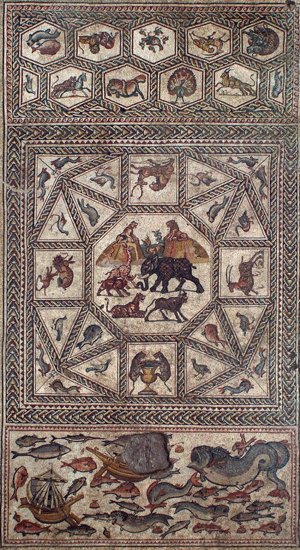
Thirteen years after one of the most beautiful mosaics ever to be seen in the country was covered over, the Israel Antiquities Authority, in cooperation with the municipality of Lod and its residents, is beginning an archaeological excavation that will re-expose the mosaic, once and for all. Some 30,000 people from all over the country visited the site during one weekend when the mosaic was on display to the public.
The 1,700 year old mosaic floor, which is one of the most magnificent and largest mosaics ever revealed in Israel, was first uncovered in the city of Lod in 1996. The mosaic is a real archaeological gem and extraordinarily well-preserved. It covers an area of approximately 180 square meters and is composed of colored carpets that depict in detail mammals, birds, fish, a variety of flora and the sailing and merchant ships that were used at the time. The purpose of the building in which the mosaic floor was placed is not known.
Read more here.
Subscribe to:
Posts (Atom)

