Showing posts with label archaeology. Show all posts

19 August 2009

3,000-year-old butter found in Kildare bog


AN OAK barrel, full of butter, estimated to be roughly 3,000 years old has been found in Gilltown bog, between Timahoe and Staplestown.

The amazing discovery of the barrel, which is being described by archaeology experts in the National Museum as a "really fine example" was found by two Bord na Mona workers.

The pair, John Fitzharris and Martin Lane, were harrowing the bog one day in late May when they noticed a distinctive white streak in the peat.

"We got down to have a look. We knelt down and felt something hard and started to dig it out with out bare hands," John explained.

Read more here.

15 August 2009

'Neolithic cathedral built to amaze’ unearthed in Orkney dig


A huge Neolithic cathedral, unlike anything else which can be seen in Britain, has been found in Orkney.

Archaeologists said that the building would have dwarfed the island’s landmarks from the Stone Age — the Ring of Brodgar and the Standing Stones of Stenness. Nick Card, who is leading the dig at the Ness of Brodgar, said that the cathedral, which would have served the whole of the north of Scotland, would have been constructed to “amaze” and “create a sense of awe” among those who saw it.

It is about 65ft in length and width and would have dominated the Ring of Brodgar and the Stones of Stenness which stand on either side. These important sites, dating back about 5,000 years, might have actually been peripheral features of Orkney’s Stone Age landscape. Mr Card said: “In effect it is a Neolithic cathedral for the whole of the north of Scotland.”

Read more here.

Study: Fire used to make tools 75,000 years ago


Early humans crossed a threshold around 75,000 years ago, when they started painting symbols, carving patterns and making jewelry. A new study found they also began to use fire to make tools around that time.

Until now, this complex, multistep process for tool making was only known to occur as recently as 25,000 years ago in Europe. But the new findings show this breakthrough occurred much earlier, and in Africa, not Europe.

By heating up stones in a fire before chipping away at them to make blades, early humans could make tools sharper and produce them more efficiently.

Read more here here, here, and here.

13 August 2009

Early Human Hunters Had Fewer Meat-Sharing Rituals


UA anthropologist Mary Stiner has discovered that early stone-age hunters at Qesem Cave were skilled big game predators but shared their meat informally.

A University of Arizona anthropologist has discovered that humans living at a Paleolithic cave site in central Israel between 400,000 and 250,000 years ago were as successful at big-game hunting as were later stone-age hunters at the site, but that the earlier humans shared meat differently.

"The Lower Paleolithic (earlier) hunters were skilled hunters of large game animals, as were Upper Paleolithic (later) humans at this site," UA anthropology professor Mary C. Stiner said.

Read more here.

11 August 2009

Archaeologists find cache of tablets in 2,700-year old Turkish temple


Excavations led by a University of Toronto archaeologist at the site of a recently discovered temple in southeastern Turkey have uncovered a cache of cuneiform tablets dating back to the Iron Age period between 1200 and 600 BCE. Found in the temple's cella, or 'holy of holies', the tablets are part of a possible archive that may provide insights into Assyrian imperial aspirations.

Read more here.

09 July 2009

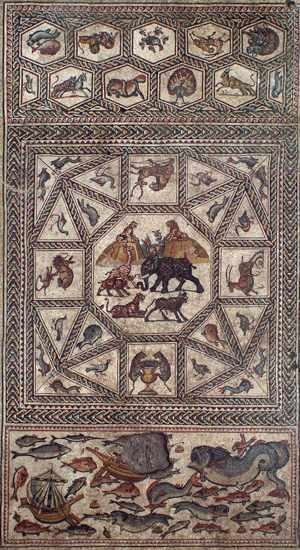
Lod Journal: Polishing a Lost Gem to Dazzle Tourists


The beauty of the exquisitely preserved ancient mosaic only seemed to underline the incongruity of its surroundings.

The late-Roman-era mosaic floor, one of the largest and finest in Israel, was unveiled by the authorities last week for just the second time since it was discovered 13 years ago in the dilapidated eastern section of this poor town near the international airport, south of Tel Aviv.

Some 1,700 years old, the magnificent tiled floor spreads over almost 2,000 square feet, shaded from the harsh summer sun by a thin awning and surrounded by a canvas fence. A panoply of colorful depictions of birds, fish, exotic animals and merchant ships, the mosaic conjures up an intriguing reminder of Lod’s more glorious past.

The archaeologists of the Israel Antiquities Authority believe the mosaic, which lacks any inscriptions, was commissioned by a wealthy individual who owned a grand villa here. Lod, which is mentioned in the Bible, was an important center in ancient times, and this part of it is known to have been a neighborhood of the rich.

Read more here.

Israeli Archeologists Unearth Herod’s Quarry


On Monday the Israel Antiquity Authority said that they believed archeologists may have unearthed a stone quarry used by King Herod—known throughout most of the western world as the Roman king of the Holy Land during Christ’s birth—to build a number of famous structures, including the Jewish Temple and the Western Wall.

The quarry appears to be just one portion of a large system of quarries located inside the ancient city.

Archeologists have indicated that the size of the stones extracted have offered clues as to what kind of construction they were used for. Some of the largest stones chiseled out of the 1,000-square-foot quarry have dimensions of roughly 9 foot by 6 foot by 6 foot—almost identical to the measurements of the massive blocks used to construct the Temple and the Western Wall.

According to Ofer Sion, director of the excavation project, “[t]he dimensions of the stones that were produced in the quarry that was revealed are suitable for the Temple walls.”

Read more here.

25 June 2009

A deeper look at Peking Man site


RESEARCHERS yesterday began excavation work in the Zhoukoudian Caves in a suburb of Beijing, where the skulls of Peking Man, or Homo erectus, were found in the 1920s and 1930s.

The work will help scientists gain a better understanding of the lives of early humans.

Researchers will excavate 20 square meters along the western wall of the site, called Locality 1, Gao Xing, deputy director and research fellow of the Chinese Academy of Sciences Institute of Vertebrate Paleontology and Palaeoanthropology, said yesterday.

Locality 1, where the first complete skull of Peking Man was found, used to be a 20-meter-wide, 140-meter-deep cave, but the ceiling collapsed. The four-month project aims to protect the western wall from further collapse, he said.

Read more here.

A life dedicated to antiquity


It’s never a good idea to keep Zahi Hawass waiting.

“You’re three minutes late,” the celebrated Egyptian archaeologist told a group of San Francisco visitors one very warm April morning at Saqqara, an ancient burial city site dominated by the world’s oldest pyramid (circa 2700 B.C.).

Hawass was standing in full Egyptian sunlight, shielded only by one of the battered, sweat-stained leather hats that have become his trademark costume pieces in public and on numerous History Channel, Discovery Channel and National Geographic TV special appearances. Hawass didn’t smile as he led his guests to the opening of a nearby cave. He rarely does.

Inside the cave, Hawass pointed out a touchingly beautiful wall carving that he believes represents a young Tutankhamun with his wet nurse, Maya, their faces close together and arms intertwined.

Read more here.

'Oldest musical instrument' found


The flutes are the oldest musical instruments found to date.

The researchers say in the Journal Nature that music was widespread in pre-historic times.

Music, they suggest, may have been one of a suite of behaviours displayed by our own species which helped give them an edge over the Neanderthals.

The team from Tubingen University have published details of three flutes found in the Hohle Fels cavern in southwest Germany.

The cavern is already well known as a site for signs of early human efforts; in May, members of the same team unveiled a Hohle Fels find that could be the world's oldest Venus figure.

Read more here and here.

24 June 2009

Forensic artists put different faces on 2,800-year-old mummy


When the 2,800-year-old mummy of an Egyptian court singer went on display at the University of Chicago's Oriental Institute in February, Emily Teeter, the curator, wished she had a way for visitors to see the young woman's face so they could better understand her.

It didn't take long for that face to reappear after nearly three millennia. Two artists stepped forward, offering to do portraits of the performer using separate police forensic methods normally employed to recreate the faces of unidentified, cold-case homicide victims.

The artists, Joshua Harker of Chicago and Mike Brassell of Baltimore, worked independently and unaware of the other's efforts, each using highly detailed CT-scan images of the skull of Meresamun, a singer who died roughly 800 years before the birth of Christ.

Read more here and here.

23 June 2009

Carvings From Cherokee Script’s Dawn


The illiterate Cherokee known as Sequoyah watched in awe as white settlers made marks on paper, convinced that these “talking leaves” were the source of white power and success. This inspired the consuming ambition of his life: to create a Cherokee written language.

Born around 1770 near present-day Knoxville, Tenn., he was given the name George Gist (or Guess) by his father, an English fur trader, and his mother, a daughter of a prominent Cherokee family. But it was as Sequoyah that around 1809 he started devising a writing system for the spoken Cherokee language.

Ten years later, despite the ridicule of friends who thought him crazed, he completed the script, in which each of the 85 characters represented a distinct sound in the spoken tongue, and combinations of these syllables spelled words. Within a few years, most Cherokees had adopted this syllabary, and Sequoyah became a folk hero as the inventor of the first Native American script in North America.

Read more here.

Bulgarian Archaeologists Uncover Intact Thracian Settlement


A team of Bulgarian archaeologists has uncovered a Thracian settlement close to the southeast town of Nova Zagora.

The team of Konstantin Gospodinov and Veselin Ignatov from the city of Burgas hope that their finding would be the first Thracian settlement to be uncovered in its entirety.

The settlement is located along the Blatnitsa River. It had a moat around it, and include large buildings rising above the ground, news.dir.bg [in Bulgarian] reported.

Read more here (in English).

Study: Food storage began well before farming

People were storing grain long before they learned to domesticate crops, a new study indicates. A structure used as a food granary discovered in recent excavations in Jordan dates to about 11,300 years ago, according to a report in Tuesday's edition of Proceedings of the National Academy of Sciences.

That's as much as a thousand years before people in the Middle East domesticated grain, the research team led by anthropologist Ian Kuijt of the University of Notre Dame said.

Remains of wild barley were found in the structure, indicating that the grain was collected and saved even though formal cultivation had not yet developed.

Read more here and read the original research article at PNAS.

Neanderthals Made Mammoth Jerky


Necessity compelled Neanderthals to dry hunks of big game meat for easy transport, according to a new study on the survival needs of Neanderthals.

Neanderthals also likely wore tailored clothing, according to the new study, which has been accepted for publication in the Journal of Archaeology.

The findings help to explain how Neanderthals could transport meat over long distances without it rotting, as well as how they survived the often chilly conditions of Northern Europe.

See more here.

Intact ancient tomb uncovered in Bethlehem


Workers renovating a house in the traditional town of Jesus' birth accidentally discovered an untouched ancient tomb containing clay pots, plates, beads and the bones of two humans, a Palestinian antiquities official said Tuesday.

The 4,000-year-old tomb provides a glimpse of the burial customs of the area's inhabitants during the Canaanite period, said Mohammed Ghayyada, director of the Palestinian Authority's Ministry of Tourism and Antiquities.

Workers in a house near the Church of the Nativity uncovered a hole leading to the grave, which was about one meter (yard) below ground, he said. They contacted antiquities officials, who photographed the grave intact before removing its contents.

They dated the grave to the Early Bronze Age, between 1,900 B.C. and 2,200 B.C.

Read more here.

22 June 2009

Lod Mosaic


Thirteen years after one of the most beautiful mosaics ever to be seen in the country was covered over, the Israel Antiquities Authority, in cooperation with the municipality of Lod and its residents, is beginning an archaeological excavation that will re-expose the mosaic, once and for all. Some 30,000 people from all over the country visited the site during one weekend when the mosaic was on display to the public.

The 1,700 year old mosaic floor, which is one of the most magnificent and largest mosaics ever revealed in Israel, was first uncovered in the city of Lod in 1996. The mosaic is a real archaeological gem and extraordinarily well-preserved. It covers an area of approximately 180 square meters and is composed of colored carpets that depict in detail mammals, birds, fish, a variety of flora and the sailing and merchant ships that were used at the time. The purpose of the building in which the mosaic floor was placed is not known.

Read more here.

Ancient Holy Land quarry uncovered, team says

Israeli archaeologists said on Sunday they had discovered the largest underground quarry in the Holy Land, dating back to the time of Jesus and containing Christian symbols etched into the walls.

The 4,000-square-meter (yard) cavern, buried 10 meters beneath the desert near the ancient West Bank city of Jericho, was dug about 2,000 years ago and was in use for about half a millennium, archaeologist Adam Zertal said.

Read more here.

Update:


Read more here.

Archaeologists unearth kiln site of pioneer master potter


In 1852, Thomas Davenport fired up a kiln in southern Utah's first pioneer settlement and started making pottery and crockery that slowly spread through the West along with his reputation as a craftsman.

The old site in Parowan, where Davenpoprt manufactured the clay pieces, is being excavated now by a team from Michigan Technological University led by a associate professor who has been studying Davenport and his work for the past 10 years.

Timothy Scarlett said the site is significant in understanding the artisans and industry of the West and culture of pioneers with The Church of Jesus Christ of Latter-day Saints who settled in the area.

Read more here.

Ancient artifacts sacred, not trivial

George Hawkins ("Let ordinary people collect artifacts," June 16) is pretty sure he can make an Anasazi pot, one that he doubts even an expert could tell from an old one.

Hawkins is likely a very skilled artist and I commend the hard work it must have taken to reach that level of skill.

But what he is making is a replica, not an Anasazi pot, because he's not an Anasazi. They disappeared from the region a long time ago.

Hawkins also thinks ordinary people ought to be able to collect ancient artifacts from public land. His thinking reveals that he is missing a large part of the picture of what ancient artifacts are and why we want to protect them.

Read more here.