
Artifacts have been found near White Sands Missile Range of the Jornada Mogollon, who lived mostly in the Tularosa Basin more than 650 years ago.
The archeological find was discovered last year during preliminary site preparation for construction of facilities for the 2nd Engineer Battalion, which was activated at White Sands in October. Archaeologists consider the artifacts "a significant discovery" because they suggest that the Jornada Mogollon temporarily occupied the site two separate times, first around A.D. 1150 and the second from about A.D. 1250 to 1350.
Read more here.
20 June 2009


Major Archaeological Find in Kent County, Delaware

A rare find in Delaware is giving archaeologists a look at how Native Americans used to live in that state. After months of digging at a site near Frederica, dozens of tools and artifacts used by Native Americans have been found.
Archaeologists hope to learn a lot from what they found. Some of the artifacts are rare. Already at the Frederica site old spear heads have been found.
Read more here.
18 June 2009
Meriwether Lewis: suicide or murder?

The small band of travelers rode north on the Natchez Trace, winding through the Tennessee wilderness en route to Washington, D.C.
Leading them was Meriwether Lewis, who just three years earlier had helped blaze a trail to the Pacific Ocean, cementing his fame and power in a young America.
On this journey in October 1809, Lewis' heart was heavy with problems. He was sick and in financial straits. The task of completing his Lewis and Clark Expedition journals weighed on the 35-year-old explorer, as did the politics of the day.
Read more here.
New Tombs Found on Luxor's West Bank
Minister of Culture, Farouk Hosni, announced today that an Egyptian archaeological mission led by Dr. Zahi Hawass, Secretary General of the Supreme Council of Antiquities (SCA), has discovered an 18th Dynasty tomb (1570-1315 BC) in the necropolis of Dra Abu el-Naga, on Luxor's west bank.
Dr. Hawass stated that the newly discovered tomb belongs to the Supervisor of Hunters, Amun-em-Opet, and that it dates to shortly before the reign of King Akhenaten (1372-1355 BC).
Read more here.
Dr. Hawass stated that the newly discovered tomb belongs to the Supervisor of Hunters, Amun-em-Opet, and that it dates to shortly before the reign of King Akhenaten (1372-1355 BC).
Read more here.
17 June 2009
Dig reveals colonial school artifacts

Two hundred-plus years ago a school on the corner of Bridge and St. George streets and financed by the Spanish government allowed boys -- both black and white -- a free education.
On Tuesday, City of St. Augustine Archaeologist Carl Halbirt was excavating the corner and musing on the similarities between then and now.
"You have the ideal version, and then you have reality," Halbirt said.
Read more here.
Digging into Maryland's Colonial past

Parts of Charles County's Zekiah Swamp are every bit as inhospitable as the name suggests, choked with tick-infested woods and boot-sucking wetlands.
But as archaeologists are discovering to their delight, in the late 17th and early 18th centuries Zekiah was a growth center for the young Maryland colony.
The site of a 1674 courthouse was found last summer. Excavations this month have uncovered what might be traces of the "summer house" that Gov. Charles Calvert built to dodge his political enemies. And diggers are searching for traces of Zekiah Fort, built in 1680 to resettle several hundred "friendly" Piscataway Indians.
Read more here.
Maya Intensively Cultivated Manioc 1,400 Years Ago

A University of Colorado at Boulder team has uncovered an ancient and previously unknown Maya agricultural system -- a large manioc field intensively cultivated as a staple crop that was buried and exquisitely preserved under a blanket of ash by a volcanic eruption in present-day El Salvador 1,400 years ago.
Evidence shows the manioc field -- at least one-third the size of a football field -- was harvested just days before the eruption of the Loma Caldera volcano near San Salvador in roughly A.D. 600, said CU-Boulder anthropology Professor Payson Sheets, who is directing excavations at the ancient village of Ceren. The cultivated field of manioc was discovered adjacent to Ceren, which was buried under 17 feet of ash and is considered the best preserved ancient farming village in all of Latin America.
Read more here.
Excavation reveals ancient aqueduct in Jerusalem

The Israel Antiquities Authority uncovered the main aqueduct that conveyed water to the Sultan's Pool during an excavation prior to the construction of the Montefiore Museum in Mishkenot Sha'ananim by the Jerusalem Foundation. The ancient aqueduct supplied pilgrims and residents with water for drinking and purification.
Most Jerusalemites identify the Sultan's Pool as a venue where large cultural events are held; however, for hundreds of years it was one of the city’s most important water reservoirs.
In an archaeological excavation the Israel Antiquities Authority recently conducted prior to the construction of the Montefiore Museum, which the Jerusalem Foundation plans to build in Mishkenot Sha'ananim, an aqueduct was uncovered that conveyed water to the Temple Mount and also served as the principal water supply to the Sultan's Pool. The excavation, directed by Gideon Solimany and Dr. Ron Beeri of the Israel Antiquities Authority, focused on a section along the course of the low-level aqueduct, on the western side of Ben Hinnoam Valley above the Derekh Hebron bridge.
Read more here.
An Interesting Idea
Dan Savage has an interesting idea for some civil disobedience . . .
Longtime gay activist Cleve Jones is leading the charge for the "National Equality March," a gay march on Washington called for October 11 of this year. Many folks are opposed—there's not enough time to organize a march, Congress isn't in session that week, marches don't accomplish much, a march eats up resources and energy—and Queerty has a good point/counterpoint interview/argument with Cleve. I'm officially agnostic: if people want to march, they can march.
But I have suggestion for an ongoing, smaller-scale action that would have a larger impact than a one-off "march" through an empty city. My idea would need fewer than a 1000 people to succeed—730 to be exact—and it wouldn't be over in a day. It would go on, day-in, day-out, every day, for a year. Hell, it could go on indefinitely. It involves civil disobedience and the 730 volunteers would have to be willing to get arrested. People who are unable to participate could make donations to help cover the expenses—legal expenses and travel expenses—of those who can.
Read more at The Stranger.
Longtime gay activist Cleve Jones is leading the charge for the "National Equality March," a gay march on Washington called for October 11 of this year. Many folks are opposed—there's not enough time to organize a march, Congress isn't in session that week, marches don't accomplish much, a march eats up resources and energy—and Queerty has a good point/counterpoint interview/argument with Cleve. I'm officially agnostic: if people want to march, they can march.
But I have suggestion for an ongoing, smaller-scale action that would have a larger impact than a one-off "march" through an empty city. My idea would need fewer than a 1000 people to succeed—730 to be exact—and it wouldn't be over in a day. It would go on, day-in, day-out, every day, for a year. Hell, it could go on indefinitely. It involves civil disobedience and the 730 volunteers would have to be willing to get arrested. People who are unable to participate could make donations to help cover the expenses—legal expenses and travel expenses—of those who can.
Read more at The Stranger.
16 June 2009
Huge Pre-Stonehenge Complex Found via "Crop Circles"

Given away by strange, crop circle-like formations seen from the air, a huge prehistoric ceremonial complex discovered in southern England has taken archaeologists by surprise.
A thousand years older than nearby Stonehenge, the site includes the remains of wooden temples and two massive, 6,000-year-old tombs that are among "Britain's first architecture," according to archaeologist Helen Wickstead, leader of the Damerham Archaeology Project.
Read more here.
A Peek into 18th-century Life
Rich Remer mined his family's Kensington past for a quarter-century.
He found deeds, wills, letters, newspaper clippings, maps, diaries. The material took him to the first Remer in the colonies, a German butcher who lived on Shackamaxon Street by the Delaware River in the mid-1700s.
A decade ago, he thought he had exhausted all leads.
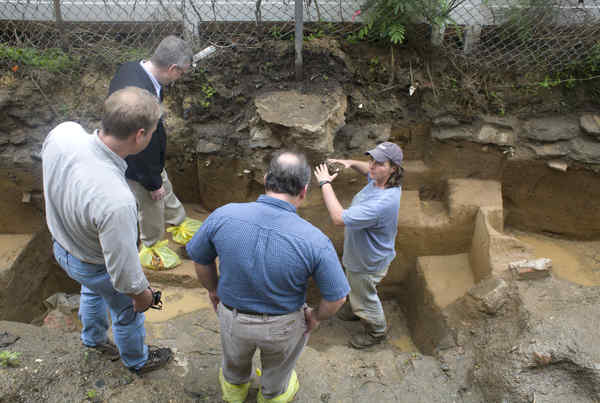
Then came unexpected news two weeks ago: Archaeologists for the state had unearthed 25,000 artifacts from a Fishtown property once owned by his great-great-great-great-great-grandfather, the butcher Godfrey Remer.
Read more here.
Lost Aztec tomb lies under Mexico City

"Archeologists digging in the dirt and black ooze under Mexico City's most important public square have been tantalized for decades by the possibility of a great treasure and likely burial place of one of the last Aztec rulers."
See more here.
02 June 2009
Save Ohio Museums: This Place Matters
On Friday, May 29, the Ohio Senate made big budget cuts that once again targeted the Ohio Historical Society. The Senate changes slashed funding for the Society from $13.56 million two years ago to $10 million for Fiscal Year 2010─a 26-percent decrease. This represents the lowest allocation of state funding for the Society since FY 1994.The Senate changes reduced the Society's Outreach Services (line 509 in the Society's state budget) from $703,638 to $0 and removed $750,000 in funding for Sites. See more here.
A Proclamation
Office of the Press Secretary
___________________________________________________________
For Immediate Release, June 1, 2009
LESBIAN, GAY, BISEXUAL, AND TRANSGENDER PRIDE MONTH, 2009
- - - - - - -
BY THE PRESIDENT OF THE UNITED STATES OF AMERICA
A PROCLAMATION
Forty years ago, patrons and supporters of the Stonewall Inn in New York City resisted police harassment that had become all too common for members of the lesbian, gay, bisexual, and transgender (LGBT) community. Out of this resistance, the LGBT rights movement in America was born. During LGBT Pride Month, we commemorate the events of June 1969 and commit to achieving equal justice under law for LGBT Americans.
See the rest here.
20 May 2009
Ancient handle with Hebrew text found in Jerusalem

Archaeologists digging on Jerusalem's Mount of Olives have discovered a nearly 3,000-year-old jar handle bearing ancient Hebrew script, a find significantly older than most inscribed artifacts unearthed in the ancient city, an archaeologist said.
The Iron Age handle is inscribed with the Hebrew name Menachem, which was the name of an Israelite king and is still common among Jews. Read more here.
07 May 2009
5760


Front: Harry and Freda Schoen and Mary Eileen and Benedict Roddy
Back: Neil Schoen (Dad's brother and Best Man), Dad, Mom, Carol Mulivihill (Maid of Honor)
06 May 2009
Palestinians busted trying to sell 2,000 year-old Hebrew scroll

Two Palestinians were arrested Tuesday for allegedly stealing a rare antique Hebrew scroll and attempting to sell it for millions of dollars.
Police apprehended the two suspects in Jerusalem after an intelligence tip allowed police forces to trace their tracks and intercept the document's sale. See more here.
30 April 2009
"Dark Age" Temple Found in Turkey

The director of this excavation, Timothy Harrison of the University of Toronto, is a friend of mine from graduate school.
An ancient temple in Turkey has been found filled with broken metal, ivory carvings, and stone slabs engraved with a dead language.
The find is casting new light on the "dark age" that was thought to have engulfed the region from 1200 to 900 B.C. See more here.
Fragment Of Hebrew Inscription From Period Of Kings Of Judah Found

ScienceDaily (2009-04-25) -- A fragment of a limestone plaque bearing several letters of ancient Hebrew script was discovered while sifting soil that was excavated in the vicinity of the Gihon Spring, within the precincts of the "Walls around Jerusalem National Park". See more here.
14 April 2009
Subscribe to:
Posts (Atom)

